The Quantum
Leap
Computing beyond the limits of classical physics. Intelligence beyond the boundaries of silicon.
How Quantum Computing Works
Superposition
Entanglement
Quantum Gates
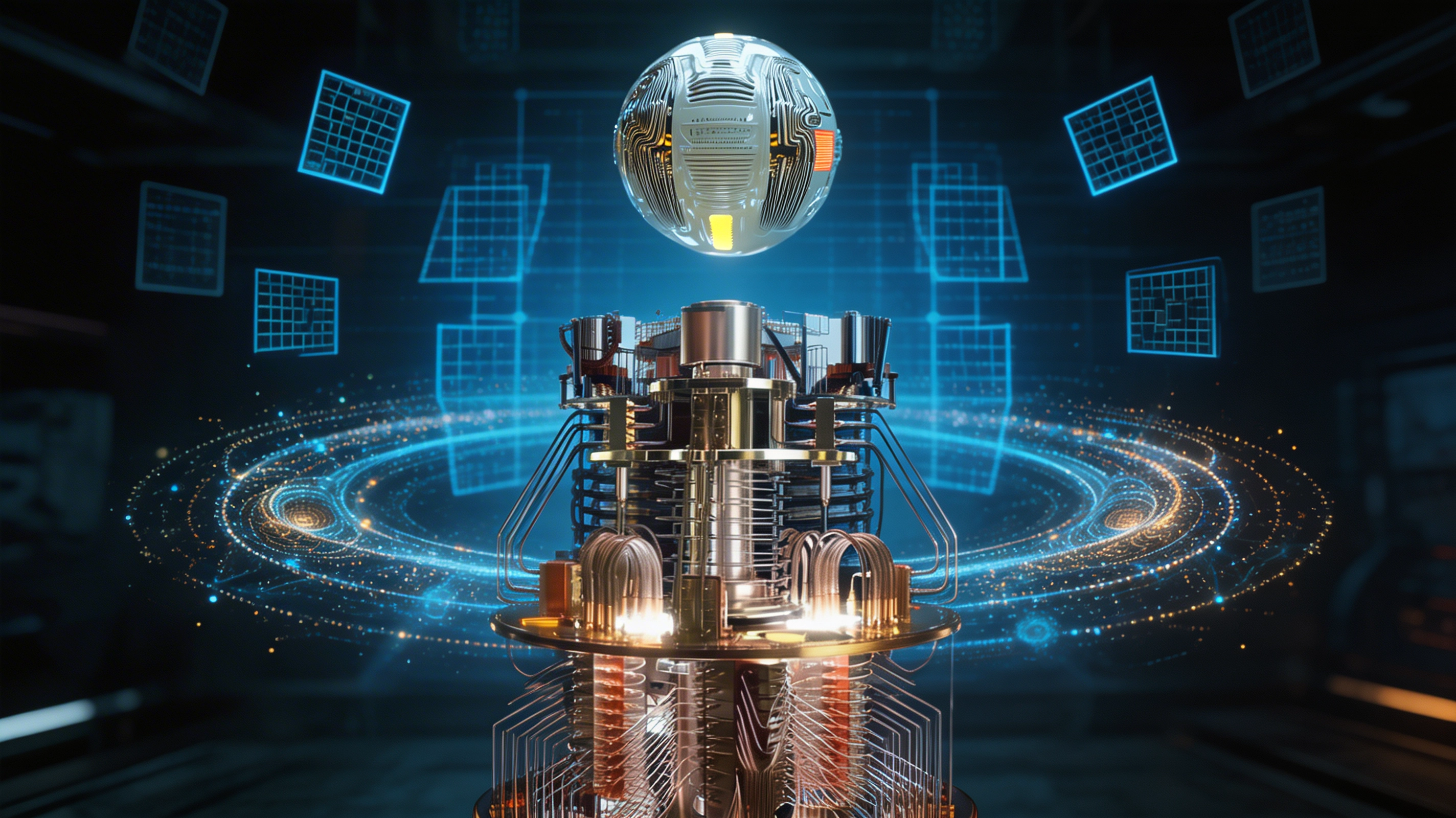
The Machine
A marvel of modern engineering, operating at the brink of absolute zero to preserve extreme computational delicacy.
Transforming Every Field
Medicine & Drug Discovery
Simulating molecular interactions to design drugs in days, not decades.
Clean Energy
Optimizing solar cells, batteries, and fusion designs at atomic level.
Artificial Intelligence
Quantum neural networks processing exponentially more data.
Cryptography & Security
Unbreakable quantum encryption and the race to protect classical systems.
Materials Science
Designing superconductors, alloys, and polymers from the atom up.
Climate Modeling
Simulating Earth's climate with molecular precision.
The Quantum Advantage
Classical Computer
10,000 yearsQuantum Computer
MinutesThe Quantum Journey
Feynman proposes quantum computing
'Nature isn't classical, dammit.'
Shor develops algorithm
Threatening classical encryption.
First 2-qubit computer
Executes Grover's algorithm.
D-Wave releases commercial system
128 qubits.
Google achieves quantum supremacy
200 seconds vs 10,000 years.
IBM unveils Condor
First processor with 1,000+ qubits.
Microsoft Majorana 1
First topological qubit chip.
Fault-tolerant systems
Quantum AI becomes practical.
Quantum AI: The Next Frontier
The ultimate convergence of hardware and software. Utilizing the principles of quantum mechanics to push artificial intelligence beyond the Von Neumann bottleneck.
Quantum Machine Learning
Training on datasets too large for classical hardware.
Quantum Optimization
Solving NP-hard problems: logistics, portfolios, protein folding.
Quantum Generative Models
Sampling from distributions classical computers cannot represent.